
Reasoning loop
Plan a step, observe its result and stop or escalate when needed.
AI AGENT ENGINEERING
Give multi-step work a reliable path from goal to completion.
We build agents that work across business systems—with scoped tools, human approval and a record of every action.

THE STARTING POINT
Agents receive a goal, choose steps and use tools to act. Your team defines the permitted systems, the stop conditions and the moments that need a person.
AI agents that act on live systems need limits before they need autonomy.
Agentic AI development from AppsGlobal builds agents with scoped tools, approval gates and full action traces.
Agentic AI development is an AI engineering service for building AI agents. Those agents are software components that receive a goal, plan the steps, call tools and act on business systems until the goal is met or a person takes over. Engineers define each agent's tools, permissions, memory and approval points. Those tools reach CRM records, ERP transactions, service desk tickets and email through APIs or the Model Context Protocol (MCP). Agentic systems are the result: one agent or a coordinated group of agents that resolves support cases, researches invoice exceptions or provisions access requests across separate applications. Each run leaves a trace of decisions and tool calls for review.
AI agents differ from chatbots, which return answers without acting on records. Scripted workflows differ in another way: their steps are fixed in code before any case arrives. AppsGlobal provides agentic AI development services as part of AI solutions and engineering, where agents act on the enterprise software a company already runs.
01 / AGENT DEVELOPMENT
A convincing demo is only a starting point. Production needs repeatable results, bounded access and a clear path to human review.

Test repeated runs, not just a single successful demo.
Scope tools and credentials to the task.
Use a fixed workflow when the steps are predictable.
Confirm API access before the agent starts work.
Expand permissions only when measured results justify it.
Agentic AI projects fail when a demonstration stands in for engineering. Five causes recur: inconsistent results across repeated runs, unlimited tool access, agents built for fixed-step work, systems outside the agent's reach and autonomy targets set above measured agent capability. Each cause surfaces inside live systems rather than in a demo.
Language models sample each next step. Each agent can therefore take a different path on identical input. One early wrong tool call carries through a ten-step task. Staff watch one case type resolve correctly one day and fail the next. Sierra's τ-bench study (June 2024) measured this with pass^k, which counts success across k repeated trials. Sierra's GPT-4o agent averaged below 50 percent success across retail and airline domains. Its retail pass^8 score fell to about 25 percent.
Agents often receive one administrator key that covers each action in a system. One misread instruction then becomes a refund, a deleted record or an email sent to the wrong customer. Instructions hidden in an incoming email or document can redirect the agent's goal. No approval step stands between the model's choice and the write action. Incident reviews afterward find no record of why the agent acted.
Invoice matching, password resets and report distribution follow the same steps each time. Agentic design adds planning calls, latency and unpredictable paths to that work without improving the result. Each run can choose a different route, which complicates testing. Anthropic's engineering guidance (December 2024) separates workflows, which orchestrate models and tools through predefined code paths, from agents, which dynamically direct their own processes and tool usage. That guidance recommends the simplest working solution, adding complexity only when outcomes improve.
Legacy applications without APIs, scattered credentials and one-off connectors block agents partway through a task. Each new tool needs custom integration code. Connector maintenance grows with each system the agent touches. Agents then stop at the first unreachable system and leave half-finished cases for staff to complete by hand.
Business cases often assume full end-to-end autonomy from the first release. Realistic office tasks involve internal tools, incomplete information and handoffs between colleagues. Projects planned around full autonomy miss their targets and lose sponsor support. Researchers led by Carnegie Mellon University tested agents in TheAgentCompany, a simulated software company with 175 tasks. Its most competitive agent completed 30 percent of those tasks autonomously (arXiv version, May 2025).
Those five causes set the engineering agenda: consistent behavior, scoped access, the right pattern, reachable systems and staged autonomy. Agentic AI development starts by choosing the pattern that fits the task.
02 / AGENT DEVELOPMENT
Start with the simplest pattern that meets the task. Explore who chooses the next step, who approves it and where each pattern fits.




Agentic AI development delivers four patterns. They differ in who decides the next step and who approves each action. Custom AI agent development selects the pattern per task, not per vendor platform.
Starting in the first two rows keeps each action visible to a person while the agent builds a performance record. Multi-agent systems add coordination overhead. They suit tasks whose subtasks need different tools, permissions or instructions. All four patterns run on one set of engineered components.
03 / AGENT DEVELOPMENT
Six components work together to turn a goal into a controlled, reviewable business action.
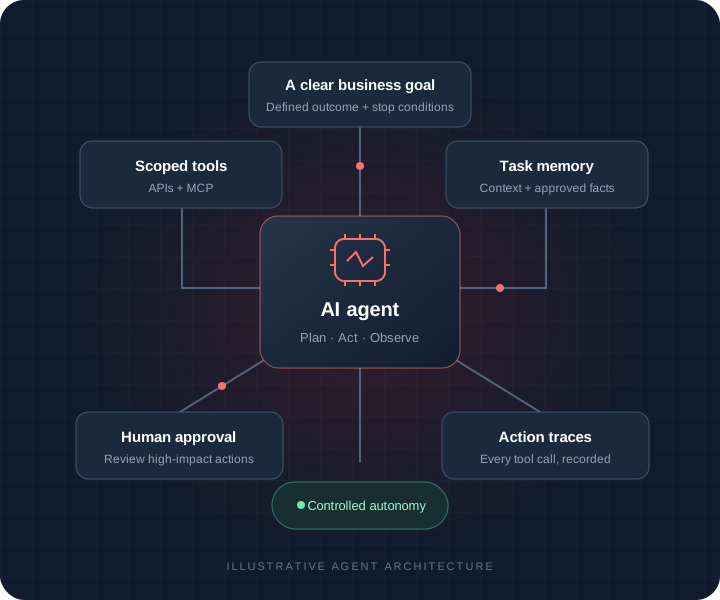
Plan a step, observe its result and stop or escalate when needed.
Give each action a typed schema and validate its inputs.
Separate task context from reusable facts with explicit write rules.
Use a dedicated identity with access limited to the task.
Set action limits and review irreversible steps.
Record prompts, tool calls, results and decisions.
Each AI agent combines six components. Weakness in any one of them shows up as a failed or unsafe action.
Reasoning loop: the language model reads the goal, chooses a step, observes the result and picks the next step until a stop condition fires.
Tool layer: typed function schemas for each permitted action, such as "read order status" or "issue refund under a set value", with input validation.
Memory: short-term context for the current task and a long-term store for reusable facts, with rules on what gets written.
Identity and permissions: a dedicated service account or delegated user token scoped to the task's systems and records.
Guardrails and approval gates: input checks, action limits by value or volume and human approval for irreversible steps.
Traces: a log of each prompt, tool call, result and decision, stored for audit and debugging.
Two open protocols standardize how these components connect. Model Context Protocol (MCP) defines how AI applications connect to external tools and data. Agent2Agent (A2A), created by Google, defines how agents from different vendors exchange tasks. Both protocols now sit under the Agentic AI Foundation, a directed fund of the Linux Foundation: MCP since December 2025 and A2A since August 2026. Planning, memory and agent coordination are explained conceptually in agentic AI concepts. Engineering work turns those concepts into a running agent through seven steps.
04 / AGENT DEVELOPMENT
Each stage answers a practical question. Open a step to see what the engineering team does before moving forward.
Launch with supervision. Expand independence after agreed success and consistency thresholds hold.
Agentic AI development raises autonomy in stages. Each stage grants more independence only after measured results justify it.
Task and decision mapping. Analysts record how staff complete the task today: systems opened, decisions made, exceptions met and approvals required.
Action risk classification. Engineers sort each action into read, reversible write or irreversible. Irreversible actions, such as payments or customer emails, receive a mandatory approval gate.
Tool and permission build. Engineers wrap each permitted action as a tool with a schema, validation and least-privilege credentials. API integration supplies the system connections, with MCP servers where target systems support them.
Agent instructions and stop conditions. Engineers write the goal format, escalation rules, step limits and the conditions that hand a case to a person.
Scenario evaluation. Engineers test the agent on real past cases, edge cases and injected malicious instructions. Measures include task success, step accuracy, repeat-run consistency and cost per completed task, drawn from large language model evaluation methods.
Supervised rollout. Agents first propose actions for staff approval. Approval narrows to high-impact actions once agreed success thresholds hold over a defined review period.
Operations and incident control. Operations teams review traces daily. Alerts flag changes in connected tools or APIs. Incident playbooks include a kill switch that halts agent actions.
05 / AGENT DEVELOPMENT
An agent that changes records needs controls at every boundary: instructions, tools, identity, memory and handoffs.

Separate trusted instructions from incoming emails, documents and web content.
Apply schema checks plus value, volume and rate limits.
Use expiring credentials scoped to specific tasks and records.
Tag sources, control writes and expire stale facts.
Set step limits and circuit breakers, and check each handoff.
Show the evidence, proposed change and expected effect.
Enterprise AI agents change records. Their security controls therefore go beyond those used for software that only answers questions. OWASP's Top 10 for Agentic Applications, released in December 2025, names the risks. Six of those risks map directly to engineering controls:
Agent goal hijack (ASI01): instructions hidden in emails, documents or web pages redirect the agent. Control: separate trusted instructions from retrieved content and confirm goal changes with a person.
Tool misuse and exploitation (ASI02): permitted tools get used outside their purpose. Control: schema validation plus value, volume and rate limits per tool.
Identity and privilege abuse (ASI03): agents act with broader rights than the task needs. Control: expiring per-task credentials scoped to named records.
Memory and context poisoning (ASI06): false facts enter long-term memory and steer later runs. Control: write rules, source tags and expiry dates for stored memories.
Cascading failures (ASI08): one agent's error spreads through connected agents and systems. Control: step limits, circuit breakers and checks at each handoff.
Human-agent trust exploitation (ASI09): reviewers approve agent requests without examining them. Control: approval screens that show the evidence, the proposed change and its effect.
Cybersecurity specialists run penetration tests against these agent behaviors before production access is granted.
06 / AGENT DEVELOPMENT
Failed attempts still consume resources. Compare total run cost against successful outcomes, then compare that cost with manual handling.
Stop runaway loops with step limits.
Use smaller models for routing and reserve larger models for planning.
Cache slow-changing tool results.
Trim completed steps from the prompt.
Hand off cases the agent has failed twice.
Enter your own run cost and successful task count.
Illustrative calculation. Include failed-run costs in the total.Agentic AI systems cost more per task than single model calls. Each task triggers repeated planning calls, tool calls and a growing context window. Failed runs consume tokens without producing a result. Cost per completed task therefore divides total run cost by successful tasks only. Five design choices keep that figure under control:
Step limits that stop runaway loops
Smaller models for tool selection and routing, with larger models reserved for planning
Cached tool results for slow-changing data, such as product catalogs
Context trimming that drops completed steps from the prompt
Early escalation of cases the agent has failed twice
Comparing cost per completed task with the staff time for the same task shows the cost difference between agent and manual handling.
07 / AGENT DEVELOPMENT
Choose by the work: variable multi-system tasks suit agents; predictable paths suit workflows; in-app assistance suits copilots.

AI agent development fits tasks whose steps change from case to case and span two or more systems. Each task also needs an outcome that staff can verify. Tasks with known steps run more predictably as fixed workflows.
Known, repeatable steps with model help at decision points belong to intelligent automation. Assistants that act inside one application at a user's request come from AI copilot development. Adding a single model call to an existing CRM or ERP screen is AI integration work.
Three AI services produce inputs that agents consume. AI document intelligence turns invoices and forms into structured fields. AI decision intelligence scores risk and forecasts demand for a person's decision. Enterprise AI search and knowledge retrieval returns cited answers from company content.
Two services sit outside the agent itself. AI software development builds new AI-native products from scratch. AI consulting and strategy ranks agent candidates against other AI ideas before any build starts.
08 / AGENT DEVELOPMENT
A named business owner works alongside specialists in architecture, tools, integration, evaluation and security.

Agent projects need a process owner from the business plus engineers for models, tools, evaluation and security. Sourcing decides which of those people come from outside.
Companies outsource agentic AI development when no internal team has built tool-calling systems before. Dedicated AI agent team contracts suit organizations planning agents for two or more departments. Organizations that hire AI agent developers into an existing engineering group keep architecture decisions in-house. Agent teams typically cover six roles:
AI agent architect: chooses the pattern, tool boundaries and approval design.
Agent engineer: writes instructions, tool schemas and stop conditions for the reasoning loop.
Integration engineer: builds API connectors and MCP servers for target systems.
Evaluation engineer: builds scenario suites and tracks success, consistency and cost per task.
Security engineer: tests goal hijack, privilege and memory risks before release.
Business process owner: defines correct outcomes and approves each autonomy change.
09 / AGENT DEVELOPMENT
Understand launch autonomy, framework choices, accountability and how staff work alongside agents.
Limited autonomy. Launch versions propose actions and wait for staff approval on each one. Autonomy widens only after the agent meets agreed success and consistency thresholds on live cases. Read-only actions gain independence first. Irreversible actions, such as payments or customer emails, keep human approval by default.
Framework choice follows the control a task needs. LangGraph models agents as explicit state graphs, which suits audited enterprise flows. CrewAI organizes role-based teams of agents. Provider toolkits such as the OpenAI Agents SDK and Google's Agent Development Kit tie closely to their own models. Engineers keep tools behind MCP or plain APIs so a framework change leaves tool code intact.
Deploying organizations carry that accountability. British Columbia's Civil Resolution Tribunal applied that principle in Moffatt v. Air Canada (February 2024). Its decision held the airline responsible for a website chatbot's inaccurate answer to a customer. Agent designs therefore name a business owner for each agent and keep complete action traces. High-impact actions pass through human approval. Legal teams review those controls for each jurisdiction.
No. Agents take over defined task steps such as gathering records, drafting updates and filing tickets. Staff keep exceptions, approvals and customer judgment calls. Role descriptions shift toward reviewing agent work and handling escalations. Workforce planning follows measured task coverage from the rollout stage, not vendor projections.
10 / AGENT DEVELOPMENT
Bring a refund investigation, access request or another task spanning two or more systems. We will map the steps, risks and approval rules.

Choose one task your staff complete across two or more systems, such as a refund investigation or an access request. AppsGlobal maps that task in a working session with your process owner. You receive a step map of each system and decision. Each action gets a risk class with its approval rule. Our recommendation then names the right build: agent, workflow or no automation. Those outputs let any agentic AI development company scope the build against the same facts.